
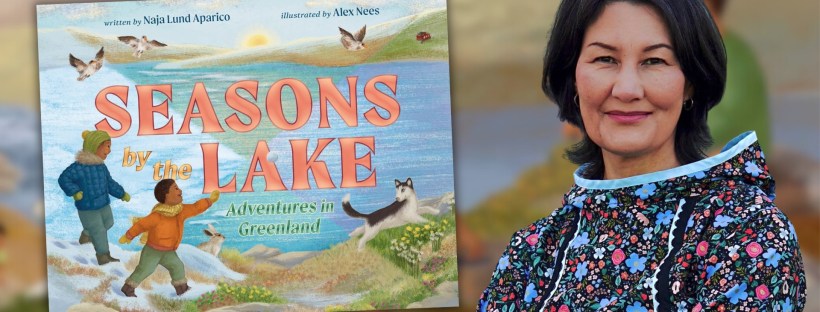
Greenland, or Kalaallit Nunaat, has been in the news a lot lately as the Danish territory and its inhabitants—the vast majority of whom are Indigenous—have faced unprovoked aggression from the United States government. Yet when pressed, most U.S. citizens would probably admit to knowing extremely little about the island, its history, and its people.
Naja Lund Aparico’s new picture book, Seasons by the Lake, explores a year of adventures in a rural Greenlandic home through the eyes of two young Inuit brothers. We recently had the chance to chat with Naja and discovered how her childhood inspired the book, dispelled some misconceptions about Greenland, and learned how readers can offer meaningful support to the Native people of the world’s largest island.
Welcome, Naja! First, thank you for sharing your culture and experiences with readers in this lovely book. What inspired you to bring this story to life for young audiences?
NLA: First of all, thank you so much for featuring Seasons by the Lake on The Baby Bookworm! I am so happy that I get to talk about my U.S. debut picture book with you. I have previously published two children’s books in Greenland, written in my mother tongue, Greenlandic. One is a picture book called My Friend Sofus, and the other is Recess, which is a middle grade novel.

The inspiration for Seasons by the Lake stems from the fact that I find joy in sharing stories about what life is like in the most remote and largest island in the world. In addition, as an Inuk, an Indigenous person, I believe representation is important—not only for the Indigenous peoples and all underrepresented people, but because I believe that every reader deserves to hear about childhood fun in other parts of the world. Not as a subject in school, not just presented as facts and data and statistics (all necessary and great!), but as silly, fun stories about childhood mischief and adventure.
We all love those stories. And if you think about it, that is what mutual understanding between different nations stems from—a universality in empathy and compassion. I believe that children’s books are the real gateway to world peace, because stories shape a child’s foundation for humanity.
What gave you the idea for basing the narrative around the changing of the seasons?

NLA: In Greenland, we spend a lot of time outside regardless of the raging storms or the time of day. There is a deconstruction of time, as well as adaptation to the harsh climate. During the Summer, children spend time in nature late into the night due to the Midnight Sun. I really wanted to share how the construction of time is not a limitation, nor is the weather a determinant for a child’s need to explore and play outdoors.
You’ve said on your website that many of Minik and Nuka’s activities were inspired by your childhood memories. Which moments of nostalgia were you particularly excited to bring to the page?
NLA: Playing in the snow during the blackness of Winter, building little huts or igloos, and sometimes bringing candles to light them inside our snow bubbles. There was an insularity and presence in the moment to let our imaginations fly.

I remember it so vividly, the sensation of the icy wind biting our cheeks and frosting our eyelashes while being bundled in layers of clothing. In addition, the epic snowball fights, imprinting snow angels deep into soft snow, and, overall, the freedom to roam and sled. I find it amazing how the simple act of sledding on a bumpy hill can cause laughing fits so hard they almost make you cry.
In a way, that jumping and bouncing in the snow can be compared to letting children loose at a trampoline park or bouncing place. It is the freedom to be a child, to be silly and goofy, and explore the outdoors on our own that made our childhood in Greenland so unique.
While the brothers engage in some childhood activities that are uniquely Greenlandic, many are also universal: playing outside, sharing a meal with loved ones, gazing at the night sky, etc. Do you think that this commonality presents an important lesson for readers?

NLA: Absolutely, a childhood is universal in regard to its wonder and joy, and its connection to family and community. That was definitely a big part of the message. Greenland seems, for some people, empty and remote, yet there are many communities living there, and the children all play and wonder in exactly the same way as other children around the globe.
In Seasons by the Lake and its backmatter, you dispel some misconceptions about Greenland; I confess, I was someone who thought Greenland was covered in ice (I apologize, and blame this scene from D2: The Mighty Ducks). What are some other illusions that you’d most like to clear away for non-Greenlanders?

NLA: LOL, the Mighty Ducks clip! And you are not wrong. Greenland is mostly covered by the icesheet, but the vast coastline is patched with rocks and land where people live. I come from the southern part of Greenland, where it is verdant during the Summers, just like its name. And it is interesting to note that the Vikings, who named the island Greenland, resided in the southern part of Greenland during a warmer period on Earth. It is safe to assume that it was even greener than it already was back in those days.
Another illusion I like to dispel—and it was mostly before this current media storm swept around the world—is people believing that the island is uninhabitable. My children have been told or asked by their friends and classmates how people can live on the island. They think that it is truly the North Pole.
As an Indigenous person, how important do you feel it is for young Indigenous readers to see themselves represented on the page and in other media geared towards them?

NLA: Growing up, I was a big reader. And the majority of my reference points were either European fairytales, Astrid Lindgren, Disney magazines, or educational material showing outdated images of the Inuit (as in, Inuit only existed in the past like relics).
This made me believe that our traditional ways of life only belonged in the past, and that our contemporary lives as Inuit were not important, and, in a sense, I did not belong in the mainstream picture. Our people and culture stayed in the periphery. Therefore, I know how important it is for Indigenous children to see themselves in books.
I know that a book with Indigenous representation will give them pride and joy, and most importantly, give them the feeling of place and belonging in the greater society.
Choctaw-German artist Alex Nees contributed some truly gorgeous artwork to complement your writing. Was it important to you to work with another Indigenous creator for the illustrations, and how did it feel when you saw the finished product?
NLA: I must admit that my favorite part of the book—aside from this amazing opportunity for me to share stories about Greenland—is Alex Nees’ illustrations. Nees has captured the essence and ambience of what I could not say with my words.

It was very important for me to work with an Indigenous illustrator, someone who is sensible to the Indigenous peoples and able to stay authentic and true to our stories. Luckily, it was not something I had to request nor fight for, because my amazing editor knew that it had to be an Indigenous person to illustrate the book. And I am incredibly grateful for working with both a wise editor and a super talented artist.
Nees’ illustrations are just stunning. Some of the pages took my breath away and made me tear up, because they seemed so familiar, like a memory.
As mentioned in the introduction, Greenland is in the midst of a geopolitical battle between the U.S. and Denmark, despite the fact that the Kalaallit people have expressed the desire to govern without the interference of either. How can readers express support for the Kalaallit’s right to sovereignty?
NLA: Thank you for asking this question. What a crazy world we live in. Never in my wildest imagination did I think Greenland would blow up in the media as it has. Readers can express support for Kalaallit by following us and sharing posts on social media. And, if so inclined, to let your representatives know about your concerns.
Another important step is to educate each other about the situation, which could be in schools or other places where there is community. And of course, read books about Greenland and Kalaallit. Especially, the ones written by us. Support Indigenous Peoples and their issues in general.
My favorite question to ask children’s writers is about the books that influenced them when they were starting their journey as readers. Are there any books from childhood that hold a special place in your heart?
NLA: My favorite question, too. I could talk about this all day! Many traditional Inuit oral stories are deeply imprinted in my heart: Stories about the Mother of the Sea, the orphan Kaassassuk, the Inland Giants, the Mountain Dwellers, ghost stories, and other myths and tales. Those are my foundation.

In terms of books that have influenced me the most, Grimm’s and H.C. Andersen’s fairytales, as well as Astrid Lindgren’s books such as Pippi Longstocking, Karlson on the Roof, and Emil from Lønneberg, would definitely make the list.
There is one Danish book called Palle All Alone in the World by Jens Sigsgaard from 1942. That book is extra memorable because it was a little scary for me to read as a child, but I loved it so much. It is about a boy who wakes up one day to find that he is all alone in the world, and he explores lots of different places and does all the things until he starts missing home and his family. It is a masterpiece and an example of amazing storytelling, not to mention that the illustrations are fabulous.
Lastly, in honor of Seasons by the Lake, what is your favorite season, and what is your favorite seasonal activity to do during that season?

NLA: That is a hard one. I think it is a tie between Winter and Summer. I enjoy spending time with family during the Christmas Holidays, because in Greenland we celebrate the season for what feels like weeks. And it is so cozy and warm during the darkest and coldest time of the year, it is a whole Arctic vibe.
Another seasonal activity is boating in the fjords during the Summer. When you are surrounded by the natural beauty and the feeling of smallness against the great mountains and the sea, everything is put into perspective. It is truly humbling. These places are so vast that you feel all alone in the world.
About Naja Lund Aparico
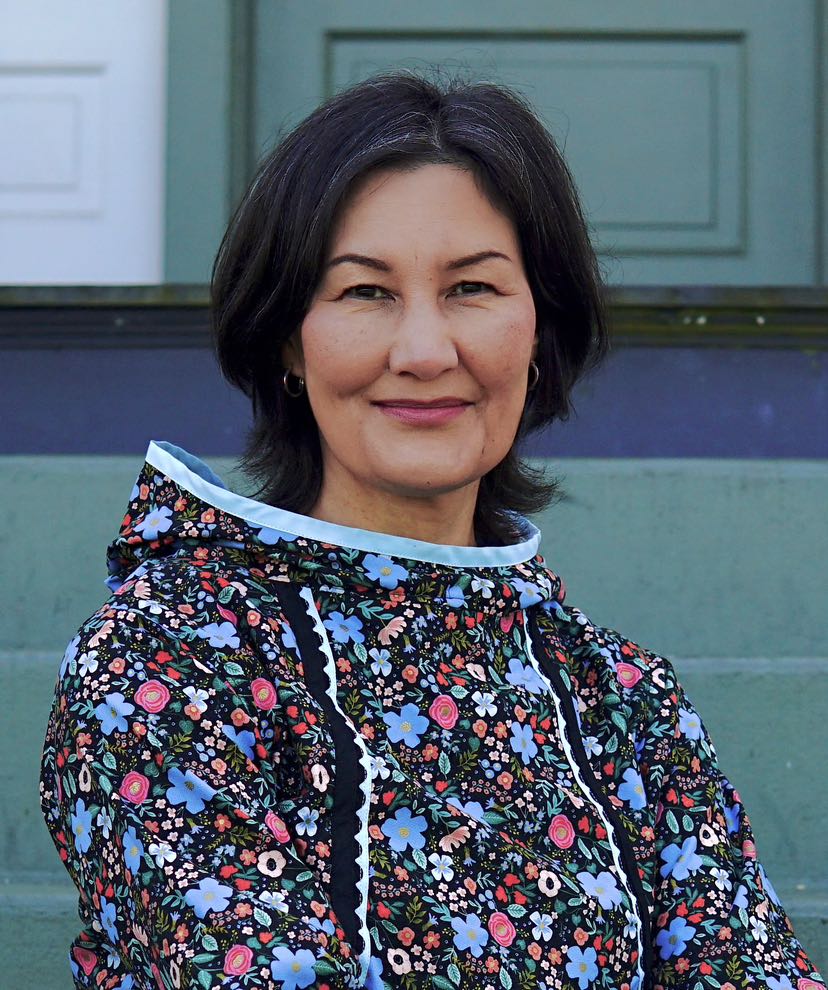
Naja Lund Aparico is a Greenlandic Inuk author with a background in international relations, and she is in the Institute of American Indian Arts’ (IAIA) low-residency MFA program in Creative Writing. Having grown up in Greenland, Naja now lives in the Pacific Northwest with her family.
A massive thank you to Naja for taking the time to talk about her work with us! Visit her on her website at NajaLundAparico.com, and on Instagram! Lastly, be sure to check out Seasons by the Lake, on bookshelves everywhere starting March 17th!
 The Baby Bookworm
One thought on “Naja Lund Aparico: One Year of Seasons in the Tremendous Beauty of Greenland”