
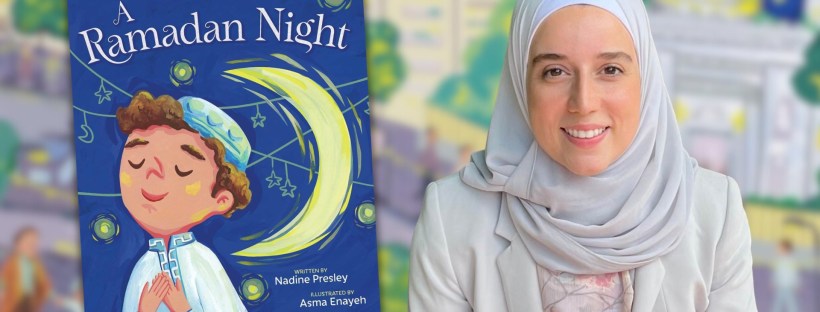
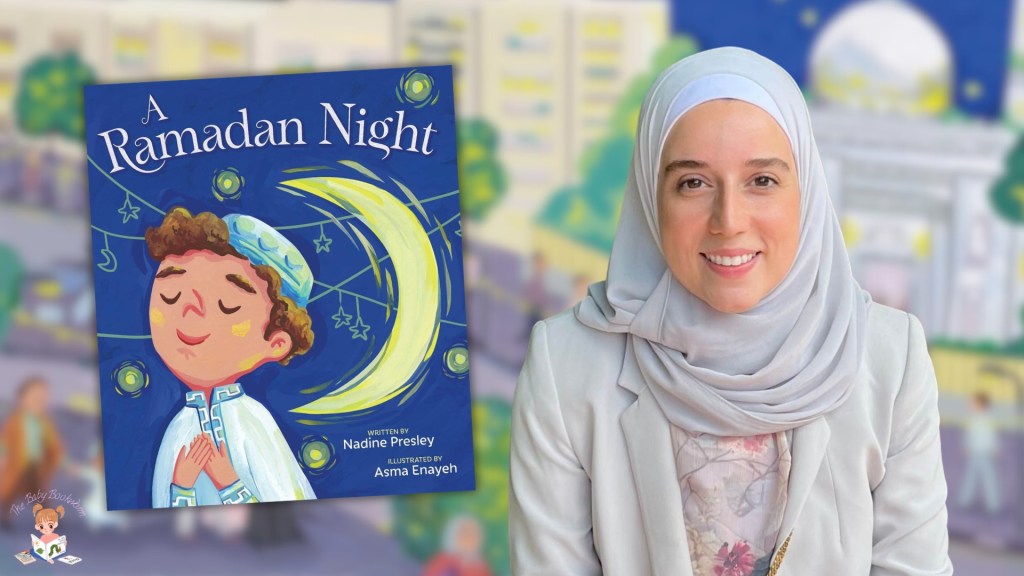
Ramadan is known to many as the ninth month of the Islamic calendar, a time for traditional fasting and prayer, as well as community and personal reflection. And with Ramadan’s observances come many sights and sounds familiar to those of the Muslim faith: fawanees lanterns, prayer rugs, kunafa, and wishes of “Ramadan Mubarak.” But what does Ramadan feel like?
That is the question of Sami, the narrator of Nadine Presley’s new picture book, A Ramadan Night. We recently had a chance to talk to Nadine about her sophomore picture book, how her memories influenced its development, and the sensory and emotional joys of Ramadan.
Welcome to The Baby Bookworm, Nadine! For readers unfamiliar with A Ramadan Night, can you introduce Sami and explain how his and Baba’s story begins?

NP: Sami is a young boy experiencing the magic of a Ramadan night through wide, curious eyes. In A Ramadan Night, the story begins as he sets out with his Baba to the mosque, walking through the brightly lit streets and noticing the sights, sounds, and feelings that make the month so special.
Rather than focusing only on fasting, the book follows Sami through the emotional and sensory layers of the night, including the glow of lanterns, the echoes of salaam, the connection of prayer, the comfort of walking beside someone he loves, and the joy of a late-night dessert.
What made you want to explore Ramadan with young readers not only as a sensory experience but also as an emotional one?

NP: Ramadan is a deeply sensory experience, but it is also profoundly emotional. It carries a tenderness, a softness, and an anticipation that lives in the heart as much as in the body. I wanted children to understand that Ramadan is not simply something we observe, it is something we feel.
There is joy in gathering, peace in prayer, pride in fasting, nostalgia in memory, and warmth in community. It is a month that heightens our senses and deepens our emotions all at once. By centring the emotional landscape of Ramadan, I hoped to move beyond explanation and allow readers to experience its intimacy, wonder, and spiritual depth from the inside out.
The book’s dreamy illustrations by Asma Enayeh seem to perfectly complement the quiet and heartfelt contemplations of Sami. How did you feel having your prose brought to life by her work?
NP: Watching Asma Enayeh bring this story to life was incredibly moving. Her illustrations did not simply mirror the text; they expanded it, adding warmth, texture, and visual emotion that deepened the reading experience.
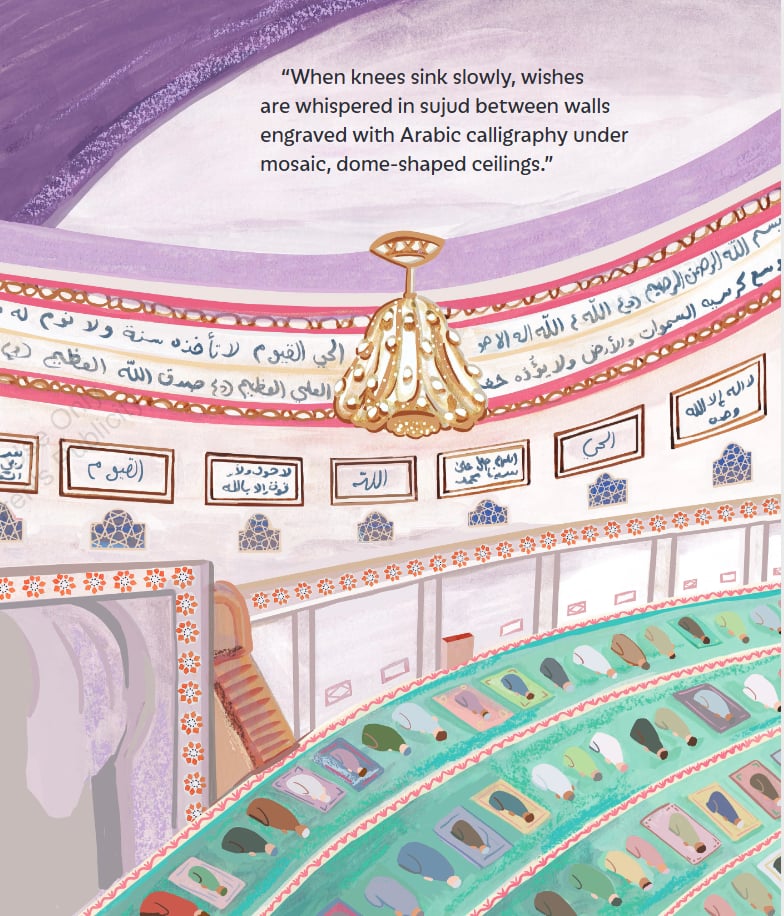
One of my favorite details is Sami wearing flip-flops over socks, which is such a familiar Syrian masjid look and makes me smile every time. And the spread of everyone in sujud beneath the mosaic dome ceilings is especially meaningful to me. Seeing such an intimate act of prayer depicted openly and beautifully in a mainstream children’s book feels powerful. I am so grateful for the care she poured into every page.
A Ramadan Night takes place in Damascus, Syria, where you are originally from. What was your favorite part of seeing your birthplace represented on the page?
NP: Seeing Syria on the page is deeply emotional for me. To see it portrayed with warmth, beauty, and dignity feels like reclaiming something precious. There is a nostalgia that comes with writing about home, a longing and a remembering, and publishing books has truly been a gift in that way.
Through stories like A Ramadan Night and my debut, The City of Jasmine, I have been able to bring a piece of home back to myself and share it with others. It feels like honoring my memories while offering readers a fuller, more joyful image of Syria.
Do you think that exploring observances of faith like Ramadan can be beneficial for readers, regardless of their own faith or lack thereof?
NP: Absolutely. Stories rooted in faith traditions are ultimately stories about humanity, about love, discipline, generosity, longing, connection, and hope. Even if a reader does not share the same beliefs, they can recognize the universal emotions within them.
Exploring observances like Ramadan expands empathy and reminds us that while practices may differ, the underlying values often overlap. Literature allows us to step into someone else’s lived experience, and that act alone fosters understanding in a way few other things can.
Sadly, some in the United States believe that Islam should not be represented in the children’s sections of schools or public libraries. As a parent and children’s creator, what are your thoughts on this?
NP: Children deserve access to stories that reflect the world they live in, and that world is beautifully diverse. Removing Islamic representation from shelves does not protect children; it limits them.
Books are invitations into understanding. Muslim children deserve to see their traditions reflected with dignity and care, and non-Muslim children deserve the opportunity to learn about their neighbors through story rather than stereotype. Representation builds empathy, reduces fear, and fosters belonging. There is space on our shelves for many stories, and that plurality strengthens all of us.

What do you most want readers of any age to take away from A Ramadan Night?
NP: More than anything, I want readers to feel wonder. I want them to close the book with a sense of warmth, the feeling of walking beside someone you love, of belonging to a community, of experiencing something sacred and beautiful.
For Muslim readers, I hope it feels like recognition. For non-Muslim readers, I hope it feels like an open door, an invitation to step inside, take off your shoes, and stay awhile. Maybe it will make young readers crave a little late-night for dessert and, if I’m lucky, will make them see the world around them with just a little more wonder.
Your website says that one of your favorite things to do outside of writing is cooking. What is your favorite dish to prepare (or eat!)?

NP: Without question, grape leaves (yabraa or dolma). They are labor-intensive, filled with rice and rolled with care, and always made in large batches, which means they are almost never prepared alone. There is something deeply communal and so much fun about making them, sitting together and talking while rolling each leaf.
And of course, eating them is just as special. They taste like home to me. Grape leaves for us are that dish that you know no one will complain about, the kids will eat, and everyone will be happy, so it’s always a win. My upcoming picture book with Harper Collins, illustrated by Leanne Hatch, is called Where There is Love, and it centers on grape leaves, memories, and magical moments in a whimsical, transportive way. I can’t wait till it’s out in the world.
My favorite question to ask children’s creators is about the books that inspired them as young readers. Are there any books or series that you carry in your heart from that time?
NP: As a child growing up in the 90s, I read everything I could get my hands on, from Robert Munsch to Shel Silverstein and so many others whose stories centered on humor, heart, and big emotion. I adored reading.
Books were a place of imagination and comfort for me, but I never really read expecting to see myself reflected in them. It simply was not in my mind that I would find my culture, my faith, or my specific lived experiences on the page. That absence felt normal because it was all I knew.
In more recent years, one of the most profound experiences for me has been reading the works of Muslim authors like Reem Faruqi, S. K. Ali, and Jamilah Thompkins-Bigelow. Seeing their stories exist so confidently and beautifully in mainstream publishing deeply affected me. Their books did not just tell meaningful stories; they expanded what felt possible. They created space. And in doing so, they reshaped the landscape for writers like me and for the next generation of readers who now get to grow up seeing themselves reflected with pride and authenticity.
Lastly, in honor of A Ramadan Night, what is your favorite part of Ramadan?
NP: My favorite part of Ramadan is the nights. There is a softness and expansiveness to them that feels unlike any other time of year. Ramadan feels spiritual in a way that is deeply tied to emotion; it heightens everything. The air feels different, conversations feel more intentional, and prayer feels more intimate.
There is joy in gathering for iftar, peace in taraweeh, and a quiet pride in the shared discipline of fasting. It is nostalgic and hopeful at the same time, grounding and elevating. If I had to describe what Ramadan feels like, I would say it feels like tenderness, like hearts opening a little wider, together.
About Nadine Presley
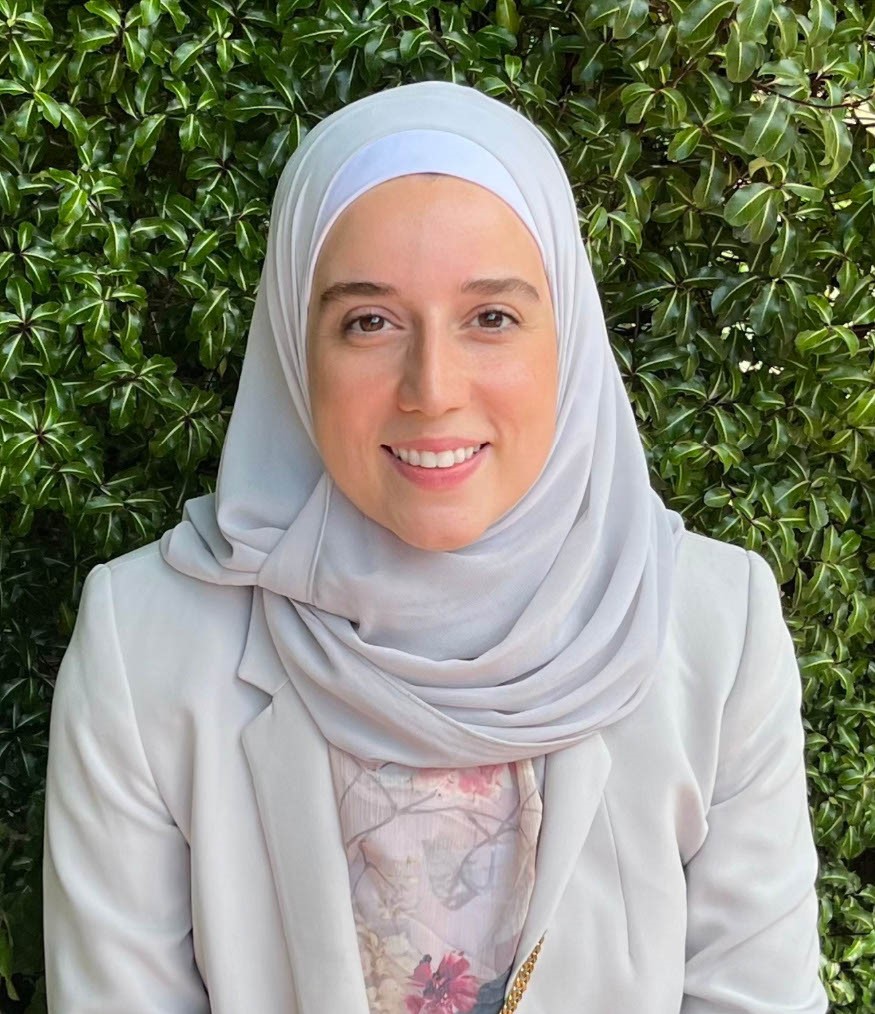
Nadine Presley is a Syrian Canadian author who loves everything about Ramadan. Her earliest memories of Ramadan go back to her days in Damascus, Syria, where she joyfully waited for the month to begin.
She now resides in Canada with her husband and three boys, working as a literacy educator. Passionate about anti-racism work and promoting pride in Arab Muslim heritage, she is also a speaker for children, youth, and adults. Her favorite things in the world are big hugs, kind words, and delicious Syrian food—especially during Ramadan.
A big thank you to Nadine for taking the time to talk about her work with us! Visit her on her website at NadinePresley.com, and on Instagram! Lastly, be sure to check out A Ramadan Night, on bookshelves everywhere now! Ramadan Mubarak!
 The Baby Bookworm