

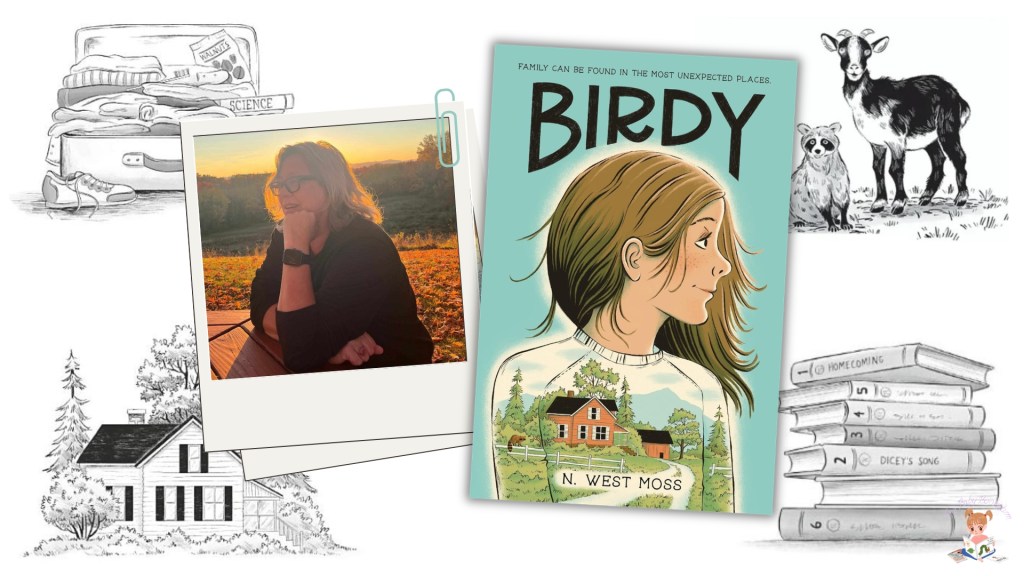
Grief is a painful and formidable companion to have, especially at a young age, and the titular protagonist of N. West Moss’s debut novel for young readers, Birdy, knows this all too well. As an eleven-year-old who has been the only source of stability for herself and her younger sibling for most of their lives, grief over losing her mother feels like just another impediment to security, especially as she navigates an uncertain future for her and her brother Mouse, and an unfamiliar home life with a family she barely knows.
We recently had the opportunity to talk with West about Birdy, her experience of writing a story for young readers, and the immeasurable impact that empathy and the environment can have on healing.
Welcome to The Baby Bookworm, West! For readers unfamiliar with Birdy, can you give a quick introduction to our heroine and what is going on at the start of the novel?

NWM: Birdy is a smart, sweet 11-year-old girl who has lived through a lot of uncertainty. She doesn’t yet see just how lovable she is. Just before the beginning of the book, Birdy’s mother has died after a long illness, and we find Birdy and her little brother Mouse on a train headed away from their home in New York City to live with relatives they’ve never met. We travel with them into the unknown, as they try to build a new home for themselves.
As a prolific writer for adult audiences, this is your first foray into children’s literature. What made you want to explore this new genre with Birdy?
NWM: When I write a story, it’s because I have a character in my mind whom I’d like to spend time with. I could picture Birdy many years ago. She was a kid who reminded me of myself. I knew that she had long brown hair, that she loved to eat pistachios, and wear comfy clothes. I pictured her with freckles across her nose and wearing a hoodie. She seemed to have a story she wanted me to tell, and so I sat down to tell her story.
I read everything, from Charles Dickens to Kate DiCamillo. I love reading everything I can get my hands on, and I have stacks of books everywhere. I don’t imagine myself as any specific type of writer. I go where my characters lead me.
That being said, my next book, which is almost finished, is also a middle grade novel, and maybe someday I’ll get the chance to write about Birdy and Mouse and Shadow and Clay some more. I’d love to spend more time with all of them.
Due to her mother’s prolonged illness, Birdy has experienced a great deal of parentification, income and food insecurity, and the lasting traumas that are associated with both. Why do you think that these are important topics to address with young readers?
NWM: One of the great gifts of being a reader is empathy. When we can picture other people’s lives, we can care about people who are different from us.
My hope is that readers will understand that there is a lot going on for all children (and adults), and that our struggles are often hidden from one another, and to be nice to one another. There is almost nothing more wonderful than being part of a community, and kids have the power to welcome others into their world without judgment.
Birdy does a lovely job of balancing the real-life issues facing Birdy and Mouse with some quirky, delightful moments of levity (I’m looking at you, Fingers). How did you find this balance in the writing, and why do you think that balance is essential?
NWM: At the beginning of Birdy, the kids are weighed down by a lot of worry. Slowly, they are able to relax and begin to enjoy themselves. Mitzie and Shadow are sweet and funny, but it takes Birdy a while to realize that.
She is the same about the natural world. At first, she is fearful of being out in the woods or by the stream, but eventually, Birdy gets a lot of joy from climbing trees, planting potatoes, and learning to swim! Her life becomes more balanced, and she is able, finally, to be more of a kid as she sheds some of her adult worries. All of the animals in the book are a great source of fun, just as animals are in my life now.
One of the main themes of the book is grief, and Birdy’s evolving relationship to and processing of it. Was this drawn from personal experience? And did translating it to the page help you in processing your own grief?
NWM: One of my biggest losses was the death of my mom a few years ago. She was one of my closest friends, and I continue to miss her and think about her every day. Unlike Birdy’s mother, my mother had a happy life, and that has made my grief a little bit easier to bear. But the truth is, we all experience grief.
We lose people we love. We lose beloved pets. Friends sometimes decide not to be our friends anymore, or they move away. These are all pretty devastating. For some reason, we don’t talk a lot about grief in our culture, so I decided I would write about it. I believe our grief is something that connects us with other human beings, if only we feel we can give voice to it.
Birdy is dedicated to Warren Balgooyen, the late naturalist, environmental educator, and director of Teatown Lake Reservation. How did Warren inspire you and this book?
NWM: Warren had a huge impact on my entire family. He was a naturalist who taught us how to tap maple trees and make maple syrup over an open fire. He planted a garden full of native plants with the neighborhood kids and took us in a canoe out to Wildflower Island. In winter, he went out on Teatown Lake and showed us how, before refrigeration, people used to cut ice out of frozen lakes and store it so that it would stay frozen into the summer!
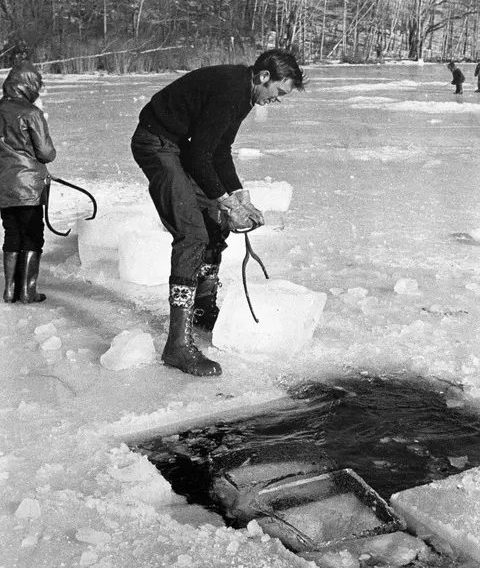
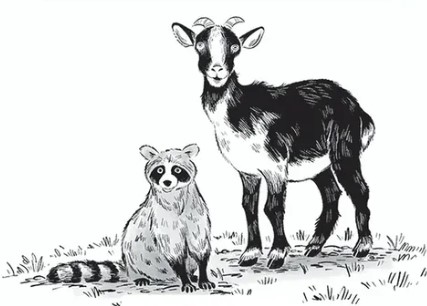
He was also a reader, and would make little signs with quotes from Henry David Thoreau that he hung in the woods around Teatown. He became the model for the character of Clay in the book. Like Clay, Warren was a gentle soul. Children, animals, and adults alike perceived that he was safe and kind. Warren had a pet raccoon named Fingers and a goat named Patches, just like Clay.
Warren really opened up the delights of the natural world to me, and it was a gift I’ve enjoyed for a lifetime. Once I started writing Birdy, I realized that I wished I could spend time with Warren again now that I am all grown up, and making him a character in this book gave me that chance.
Carrie Shryock’s charming artwork adds so much to Birdy. Was this your first time working with an illustrator, and how did it feel seeing your words realized in Carrie’s illustrations?
NWM: I never got to work with an illustrator before, but the artist Raul Colon’s artwork was on the cover of my second book, which was exciting to me. Both of my parents were artists, so getting to have his work in my book made me happy.
As for Carrie Shryock, well, I was moved by her artwork for Birdy. Writers work alone most of the time, so getting to collaborate with her to bring Birdy to life meant a lot to me. It was great to see which scenes she chose to bring to life.
For instance, I was so happy that she did a drawing of the 3-legged couch in the book, because that couch was inspired by a friend’s couch, which was also perched on 3 legs and a stack of books. Her drawing of Fingers and Patches made me laugh out loud. It is perfection!
There is something magical about making up a world in my own mind, and then having someone else see it and make it visible to the world. She was the perfect illustrator for this book, and we were lucky to get her talents for Birdy.
Overall, what is the biggest lesson that you want young readers to take away from Birdy’s story?
NWM: Mainly, I hope readers come away from this loving Birdy and Mouse. There are lots of lessons I suppose someone could take away, such as the fact that keeping a journal can be a really good thing. Also, that the natural world can be a healing and magical place, but mostly, it’s a book about healing and building a family out of the people who love you the most.
My favorite thing to ask authors is about the books that inspired them when they were children. Are there any books or series from childhood that helped you become the reader and writer you are today?

NWM: I have been a big reader my whole life. I’ll tell you something that I’ve never shared before. When I was little, I slept with books under my pillow to keep me company! Many books inspired me, but none more so than Harriet the Spy by Louise Fitzhugh. She wears a sweatshirt, just like Birdy does! But more than that, she was a smart, emotionally complex girl, just like I was.
My father and I read every night before bed, and when I was nine years old, we decided to tackle David Copperfield by Charles Dickens. It took us a whole year to read that book, and it was one of the great delights of my life.
Dad also found all 13 of the original Wizard of Oz books at thrift stores. The W. W. Denslow drawings are etched in my memory. So I guess lots of books helped me become the reader and writer I am today.

Lastly, in honor of Birdy, what is your favorite way to experience the natural world?
NWM: I like to be outside as much as possible. Sometimes, I lie in our hammock and read under the big maple tree. I also garden, and I choose plants that specifically attract butterflies, bumble bees, and hummingbirds. I also like to walk in the woods. It is so peaceful and gives me time to think and exercise. Sometimes, on a weekend, my husband and I will eat dinner out on our porch, just to be outdoors.
About N. West Moss
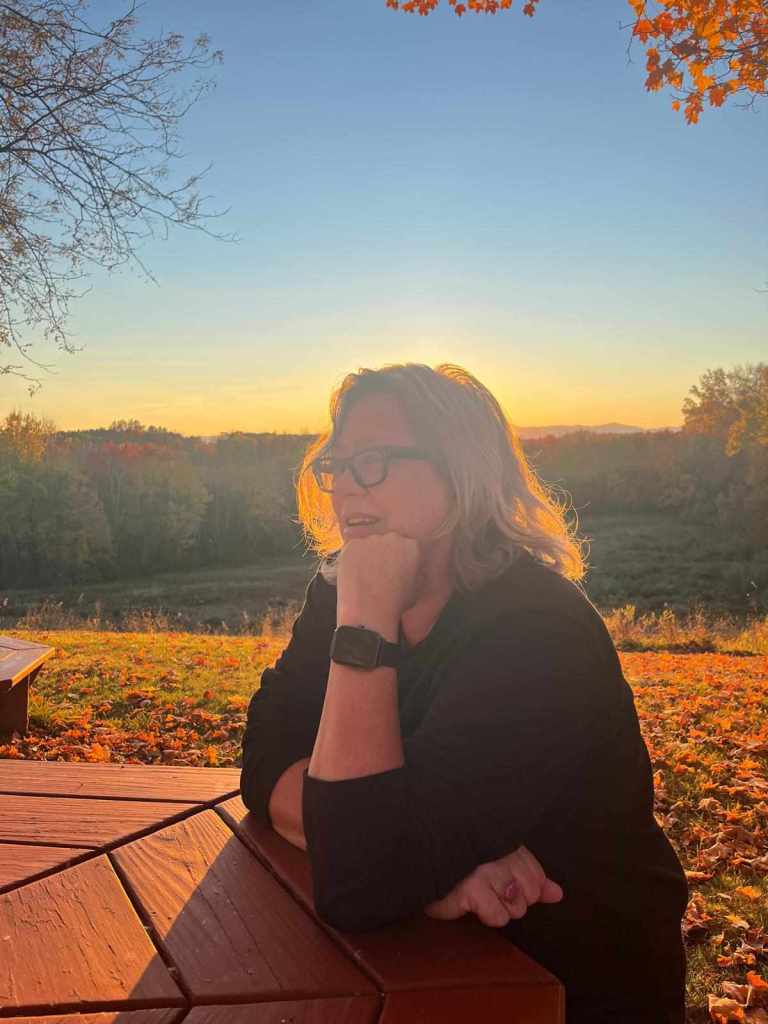
N. West Moss is the author of the story collection The Subway Stops at Bryant Park. Her essays and short stories have appeared in the New York Times, Salon, McSweeney’s, and many other publications. The recipient of three William Faulkner – William Wisdom gold medals and winner of the Saturday Evening Post’s Great American Fiction Contest, she holds an MFA in creative writing and a certificate in narrative medicine from Columbia University. She works in New Jersey, where she lives with her husband.
A warm thank you to West for taking the time to talk about her work with us! Visit her on her website at NWestMoss.com, and on Instagram! Lastly, be sure to check out Birdy, on bookshelves everywhere now!
 The Baby Bookworm