As the author of Are You There God? It’s Me, Margaret., Tales of a Fourth Grade Nothing, Superfudge, and dozens more groundbreaking novels for children and teens, Judy Blume is considered by many to be one of the all-time most influential authors for young audiences. From writing deeply relatable stories and characters to tackling real-life issues that were (and still are) considered taboo, Blume has touched generations of readers with her stories.
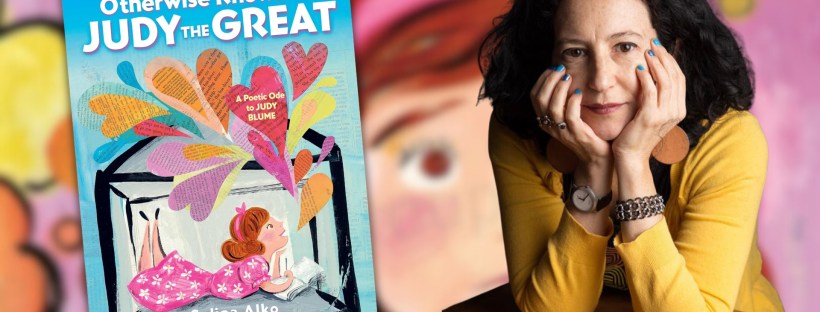
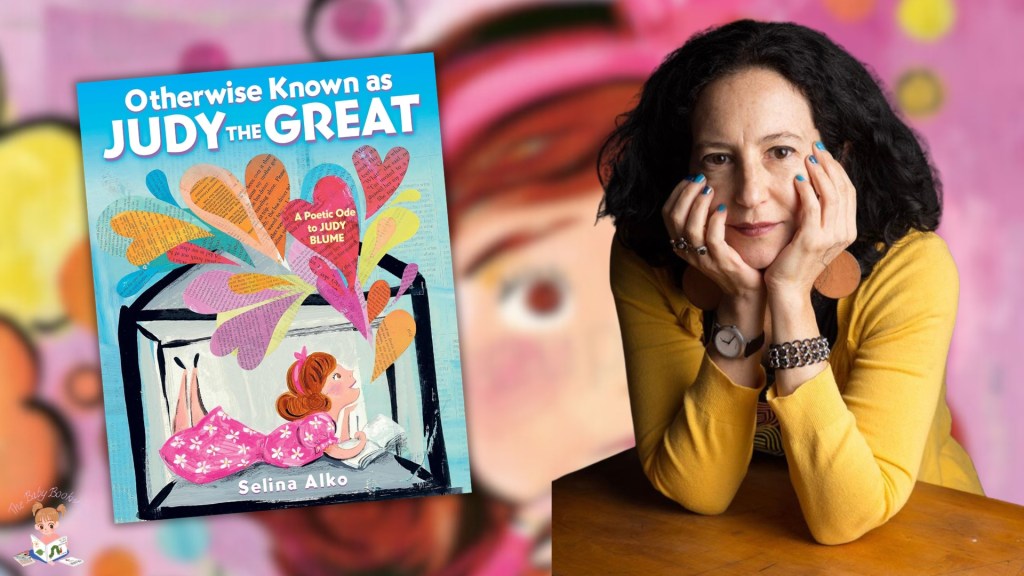
In her new picture book, Otherwise Known As Judy the Great: A Poetic Ode to Judy Blume, author-illustrator Selina Alko explores the formative events of Judy’s childhood that inspired her journey to becoming a writer. We recently had the chance to chat with Selina about the book, her creative process, and how Blume has inspired her as a reader, writer, and artist.
Welcome to The Baby Bookworm, Selina! A simple question to start: what led you to create a picture book biography of Judy Blume?

SA: I was totally obsessed with Judy Blume books growing up! Who was this incredible woman who wrote all of my favorite childhood stories? I needed to know more.

Blume’s work as an adult has inspired and touched so many people over her nearly seventy years of publishing. What made you want to focus on her experiences as a child for your book?
SA: My book is meant for children younger than Judy typically wrote for, so I wanted to focus on a time in her life close to my audience’s ages. When I looked into Judy’s childhood, I found all sorts of things that kids could relate to—incidents and anecdotes that helped shape who she became.
The book is comprised entirely of poems that capture snippets of young Judy’s life, and reads almost like a journal or diary at times. What made you choose this format as opposed to a more linear nonfiction or prose biography?
SA: I thought a traditional biography would be boring for such a superstar! The diary-like approach was meant to echo Judy’s confessional way of writing, like how Margaret asks questions and talks to God in Are You There God? It’s Me, Margaret.

I heard that you also got to work with Judy directly as the book was coming together! Can you tell us a little about what that collaboration was like, both as a creator and a fan of her work?
SA: It was a total thrill! I sent her a near-finished dummy [i.e., a rough mockup of the book] before soliciting any feedback. I really didn’t know if she would respond. Fortunately, she did and was remarkably warm and forthcoming.
She shared some key details with me. For example, I had assumed she had a very difficult relationship with her mother based on everything I had read. But when Judy saw my dummy, she felt I was much too hard on her mother. She let me in on some of the positive parts of their relationship, like how her mother took her into Manhattan to shop and see Broadway shows.
You also made the gorgeous mixed-media artwork for the book. Was there a particular spread that was a favorite, or that you found challenging?
SA: I really enjoyed coming up with the concept of the “Close-Knit family”—an illustration of Judy’s family huddled together in ONE cardigan sweater. At first, I assumed Judy’s grandmother would be at the top, almost like the head of a family tree. But, no, Judy said it was most definitely her father at the head! I’m grateful she was able to clarify that before I went to final art.

The style of your artwork also offers so many details for readers to spot. Do you ever hide secrets or personal messages to loved ones in your illustrations?
SA: Sometimes I hide words that are meaningful to me in the artwork. These words (or images) add layers of depth or dimension to the storytelling and may or may not be noticed by the reader.
The “Unlikely Events” poem is about one winter when there were three airplane crashes in Judy’s hometown of Elizabeth, NJ. The children were so frightened they thought aliens might have invaded! On this art spread, I hid the following words within the collage: extraterrestrial, God, interstellar, catastrophe, and fears.
This book is all about how young Judy’s experiences influenced her later works. Are there any foundational moments from your childhood that led you to become an author-illustrator?
SA: Before Judy Blume, I was really into Richard Scarry. His books with their word + image pairings were absolutely mesmerizing to me.
Additionally, I spent summers at a progressive Jewish camp where I painted murals, sang songs, explored social justice issues, and formed lifelong friendships.
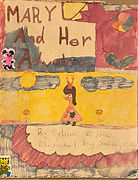
During the school year, I kept a (pretty crudely) illustrated story booklet called Mary and Her Adventures. Looking at it now, the book was like a diary in a way. My mother said I talked about how it would get published one day.
Some of your previous books address similar issues to the ones that Blume tackled over her writing career, such as religious, racial, and cultural intolerance. Why do you think that these issues are still so important to talk about with the young readers of today?
SA: Kids are smart—they are aware of social hierarchies and intolerances. One of my books, The Case for Loving: The Fight for Interracial Marriage, tells the story of how one couple fought to legalize interracial marriage. My own kids wouldn’t be born if those racist laws hadn’t been overturned in 1967. (They are biracial).

Unfortunately, discrimination is still rearing its ugly head—with immigrants being the latest targets of hatred. I created I is for Immigrants as a loving tribute to cultural diversity. We need books with affirming messages to counter bigotry now more than ever.
Also, like Blume, a few of your books have been banned from certain libraries and schools for containing “progressive” themes. As a creator, what are your feelings on these types of book bans and the effect that they can have on young readers?
SA: When I hear about books meant to foster empathy and help children cope with difficult feelings are being kept out of their libraries, I am totally perplexed. It makes me realize just how powerful (i.e., threatening) “progressive” themes are.
When I was young, I read Iggie’s House, Blume’s book about a black family moving into a predominantly white neighborhood in the 1970s. I remember feeling so upset about racial segregation. The book expanded my empathy by introducing me to the issues with relatable characters. I am so glad Iggie’s House wasn’t banned from my elementary school library!
Lastly, in honor of Otherwise Known As Judy the Great, what is one book from her catalog that you would recommend to anyone unfamiliar with her work?
SA: Starring Sally J. Freedman as Herself is one of my all-time favorites. The hot Miami beach sun and salty warm air in Blume’s pages put the reader right alongside the protagonist, Sally J., as she navigates her family’s move to a warmer climate due to her brother’s illness.
Making new friends and dealing with family dynamics in the shadows of WWII are vividly portrayed by Judy. It turns out this book is Judy Blume’s most autobiographical—Judy’s family also temporarily moved to Florida to help her sick brother recover. The story holds up remarkably well today!
About Selina Alko
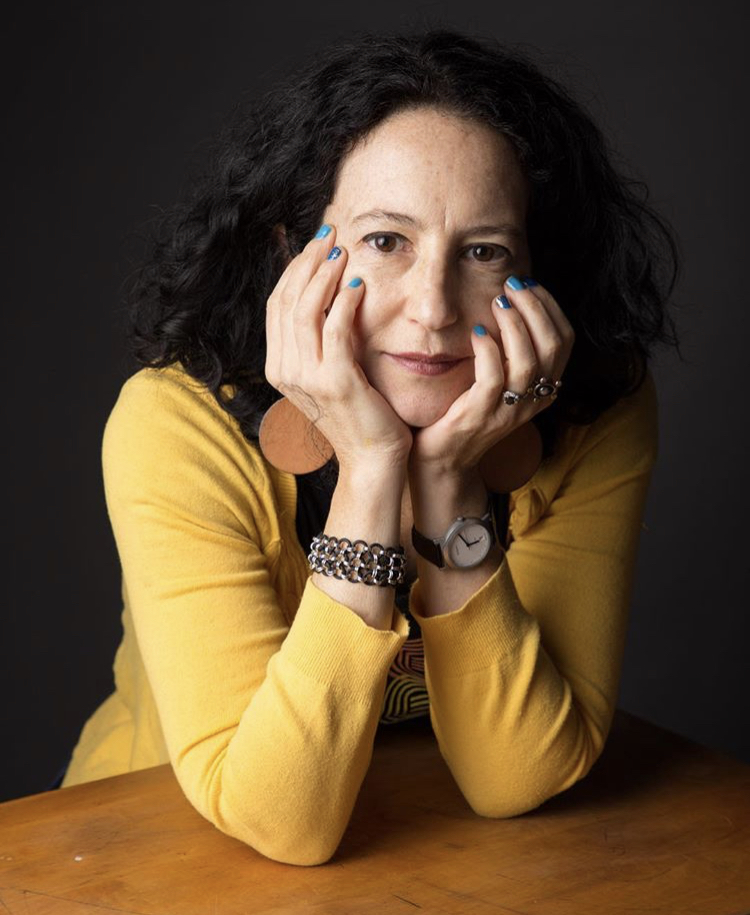
Selina Alko is an award-winning author-illustrator of many books for young readers, including I Is for Immigrants, B Is for Brooklyn, Daddy Christmas & Hanukkah Mama, Joni: The Lyrical Life of Joni Mitchell, and The Case for Loving: The Fight for Interracial Marriage (co-illustrated by Sean Qualls).
She lives in Brooklyn with her family.
A heartfelt thank you to Selina for taking the time to talk about her work with us! Check out her website at SelinaAlko.com, and be sure to check out Otherwise Known As Judy the Great: A Poetic Ode to Judy Blume, on bookshelves now!
 The Baby Bookworm