Even the youngest of readers knows that each book must have three things: a beginning, a middle, and an end. So what happens if one of those critical elements decides to go missing?
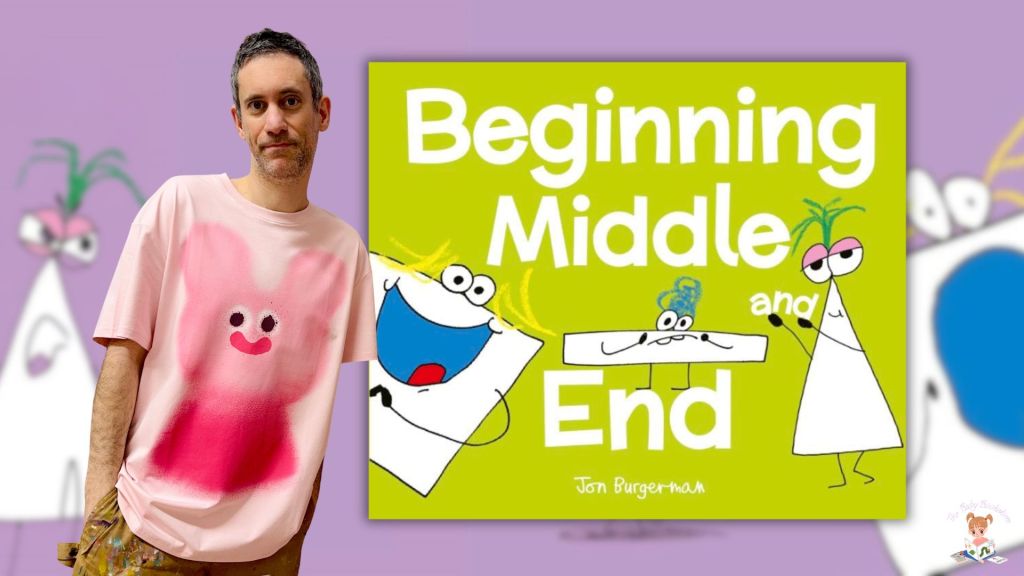
In Jon Burgerman’s newest picture book, Beginning, Middle, and End, the reader playfully explores classic story structure through a meta-disagreement between the book’s own beginning, middle, and end. We had a chance to talk to Jon about Beginning, Middle, and End, its homegrown inspirations, and the fun of creating art for the imaginations of all ages.
Welcome to The Baby Bookworm, Jon! Can you give us a brief introduction to the characters of Beginning, Middle, and End, and how their conflict arises?
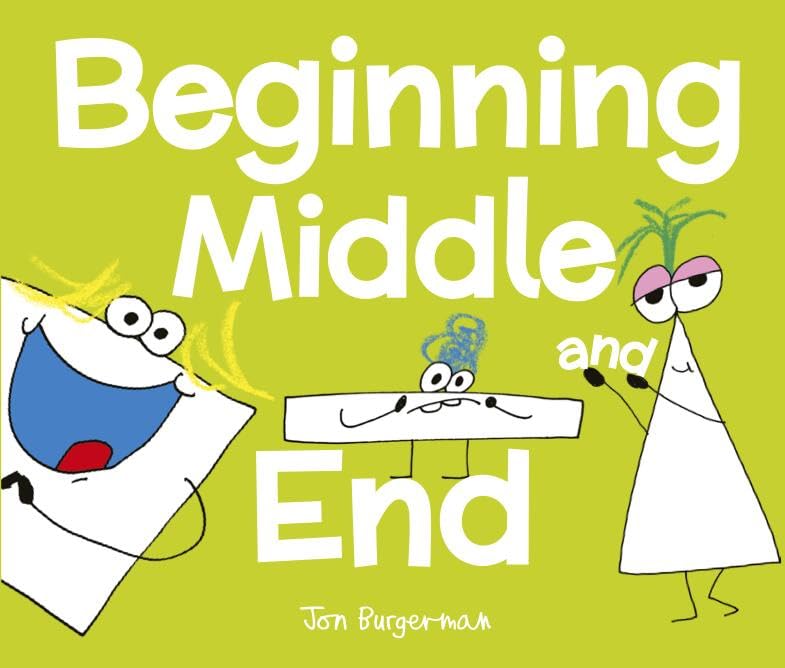
JB: Each character believes they are the integral ingredient to what makes a story. But they quickly realise that without each one of them, a story doesn’t work.
Beginning is chatty and chipper, because they like starting a story. Middle is a little impatient; they want to get to the part of a story where things really start going (and involves them). The End is more calm and measured; they’ve seen it all before, the happy endings, the sad endings, and everything in-between. They understand all stories must reach and end…!
Meta children’s books are very popular with kids, as they allow a creative look at how stories are crafted and brought to the page. What are you hoping young readers take away from this story?

JB: I hope they will enjoy the story as just a fun picture book, but then hopefully think about the other books they like and how they are structured. Maybe they’ll even be inspired to write their own Beginning, Middle, and End stories.
I also hope they realise when thinking about how stories work, one important element of a story that the characters are a little oblivious to, that there needs to be… conflict!
You’ve dedicated this story to your two brothers, and it’s apparent that the characters have big sibling energy. Was the story inspired by any particular arguments growing up?
JB: I wanted to write a book about squabbling siblings (based on my many years experience of being a middle child). This book is what came from that.
I don’t think any one argument stands out (despite there being so many to choose from), but it’s very relatable to jostle for attention when you have siblings like the characters in this book do.
How did you come up with the design for the characters? Are they also based on you and your brothers, or did they have a completely different inspiration?
JB: I wanted to keep the designs for the characters very simple, which is actually a little tricky. They needed to look related but also distinct.
Beginning is like the first page of a (picture) book—a square. I love a blank piece of paper, it’s so exciting, full of potential, anything can happen on it!
Middle is a rectangle, they are wider, and can stretch out to be as long as they need to be, like the middle of a story. Perhaps they’re prone to going on for a bit too long…?
The End, who is a triangle, comes to a deceive end, the top of the triangle. That top point of the triangle is like the final full stop at the end of a story. All stories lead to that final moment… the end of the End.
I also wanted the characters to be super easy for kids to draw, so they can make their own versions of them.
While this is not your first children’s book, you are perhaps best known for your visual art, which has been exhibited in galleries and museums around the world. What keeps drawing you back to creating art for younger audiences?
JB: I create for myself! I am the audience, really. I’m really curious about creativity and just want to see what I can make and where it can lead me.
You’ve said of your work that you want it to embody playfulness, joy, and a sense of connection through the anxieties of the larger world that we all share. Do you feel that these qualities are especially important for children’s media?

JB: I think it’s important to create works that don’t talk down and that treat children with respect, and acknowledge a whole spectrum of emotions, not just happy ones.
Children are a wonderful audience to create for; there’s no cynicism in their reactions, they’re very honest and tell you what they really think. I wish more adults acted like children.
Do you have any more children’s books in the works?
JB: Yes, I’m making a new one right now. I mean, right now, I should get back to it after these questions!
I always love to ask children’s creators about the books they loved when they were young. Are there any books or series that still hold a special place in your heart?
JB: Picture book-wise, the one that sticks in my mind is the Dr. Seuss book The Cat in the Hat Comes Back—I loved the escalation of the pink stain and all the little cats. I also think I like stories with snow in them.
Lastly, in honor of Beginning, Middle, and End, what is your favorite part of a new story: the beginning, middle, or ending?

JB: Ahh, I guess I’d have to say the Middle…! 🙂
About Jon Burgerman
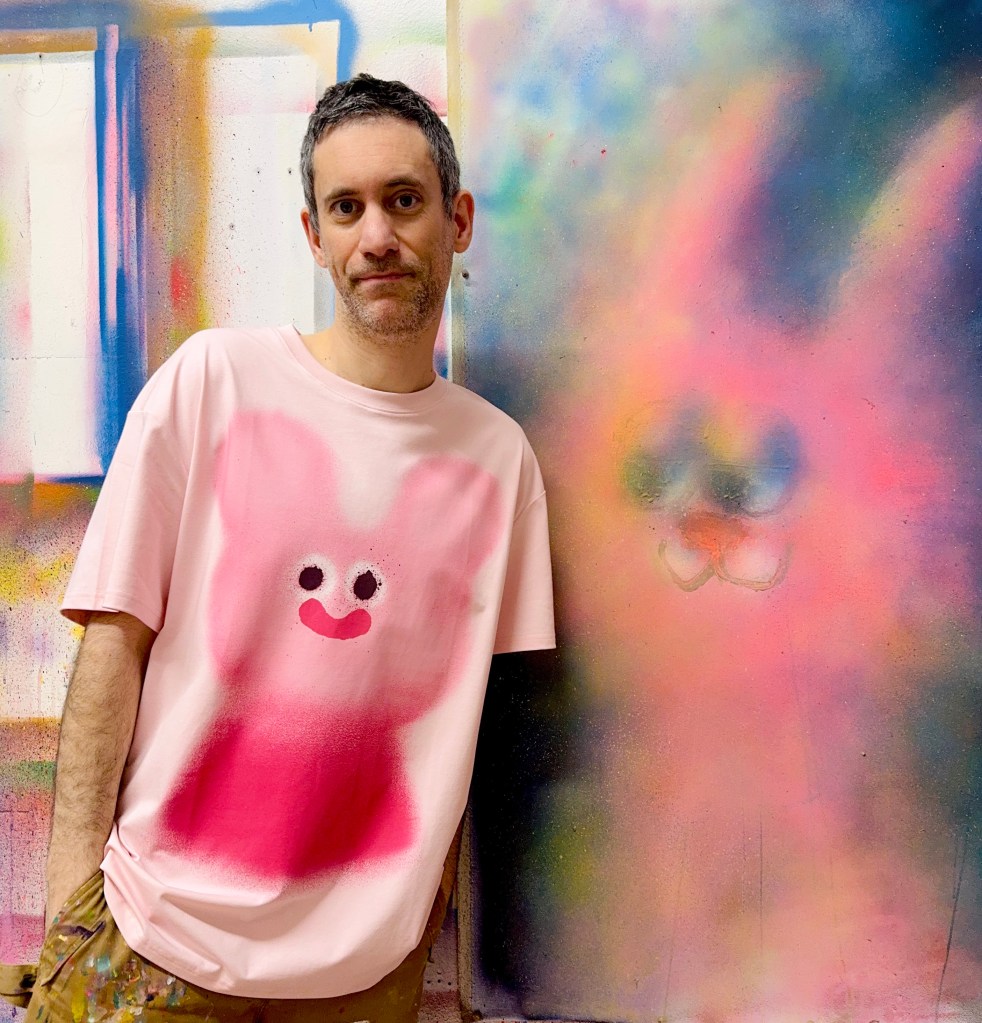
Jon Burgerman is a New York-based British artist whose works have been acquired by prestigious public collections, such as London’s Victoria and Albert Museum and the OÖ-Kultur Museum in Linz, Austria.
His art has been described as “bright, and intuitive, focused on the visceral energy of play as a tenet of communication” (Cate McQuaid, The Boston Globe, July 2021). In recent years, he has exhibited at WOAW Gallery (Hong Kong), Chengdu Times Art Museum (China), MISA Art fair Berlin and Cologne, Ojiri Gallery (London), L21 Gallery (Spain), Dopeness Art Lab (Taipei), and Jane Lombard Gallery (New York).
Burgerman’s highly distinctive fuzzy-edged characters epitomise the paradoxes of contemporary life. Their seemingly simple googly eyes betray a range of emotional complexities and anxieties, with comically distressed expressions and collapsing forms underlined by titles such as Xanax, Dualist, Lexapro, and Chameleon (2022).
A massive thank you to Jon for taking the time to talk about his work with us! Check out his website at JonBurgerman.com, and be sure to check out Beginning, Middle, and End, on bookshelves March 3rd!
 The Baby Bookworm