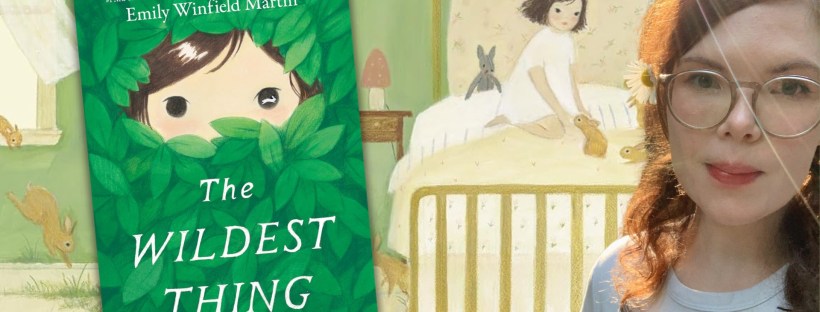
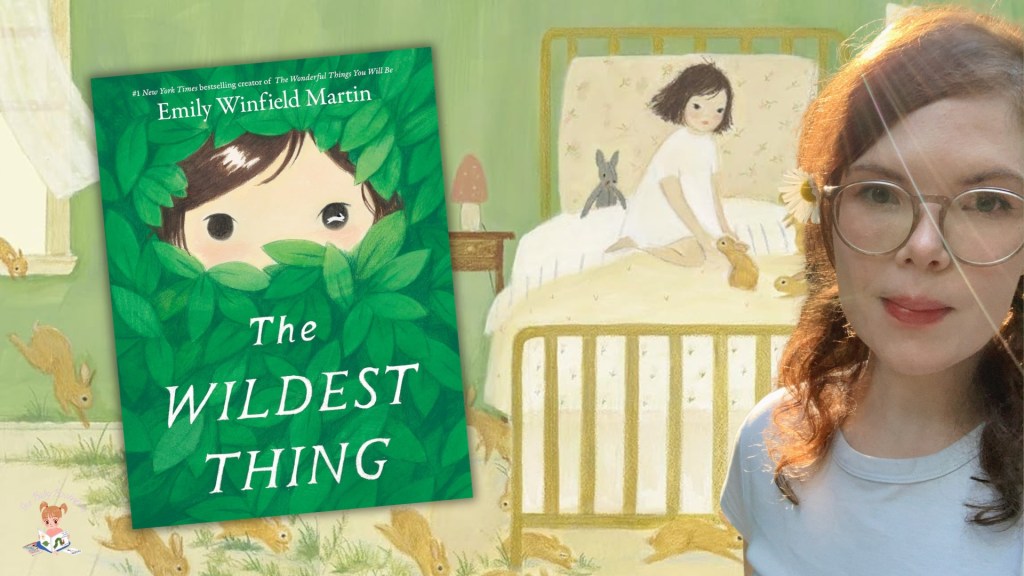
When you’re little, it can be tough to follow all the silly rules that grownups seem to hold so dear. After all, if we think back to our own childhoods, wasn’t it the most fun when we got to be a little wild? In author-illustrator Emily Winfield Martin’s newest book, The Wildest Thing, a little girl named Eleanor proves that letting the wild in—and our most wild selves out—can often help us feel most free, and most at peace.
We recently had a chance to chat with Emily about her latest picture book, capturing the connection between humanity and nature, and how inspiration can come from the most unlikely places (such as a squirrel in the walls).
Welcome to The Baby Bookworm, Emily! Can you give our readers a brief introduction to Eleanor and where she finds herself at the beginning of The Wildest Thing?

EWM: I think of Eleanor at the beginning as someone who appreciates the wild around her, while not necessarily thinking of herself as one of those wild things. But what she realizes, what comes out of some true place deep inside, I think, is that the wild she so loves so much is actually a mirror.
Your work gorgeously illustrates the affinity that so many children have for the natural world. Why do you think that this connection is so prevalent, and how did you try to capture it in your art and prose?

EWM: Thank you for seeing that connection in my work. For me, the interconnectedness of nature & children (and just people, really) isn’t something I often think about in a deliberate way, because it’s just in every cell, every bit of me, and informs everything about the way I perceive the world.
When I was little, the forest was my friend. The lake and ocean were my friends. The caterpillars and butterflies and ladybugs were my friends. I think that affection, that curiosity, that sense of companionship with the wild world is something innate to children, and the luckiest of us carry that along.
Watching Eleanor interact with a household that has become wild is a delightful depiction of the powers of imagination. What message do you most want imaginative young readers like Eleanor to take away from this book?

EWM: I think the seamlessness, the dreamlike but matter-of-fact reality with which Eleanor’s house becomes wild is to me the way children experience imagination. Like the connection to nature, it’s innate.
It’s only for the outside grown-up world not to disrupt it!
In the world of children’s literature, the phrase “wild thing” naturally conjures the timeless work of Maurice Sendak. Was Where the Wild Things Are a source of inspiration for The Wildest Thing, or was it inspired by something entirely different?
EWM: Well, the inspiration actually came from an intrusion of Wildness that happened in our own house several years ago: a squirrel got into our wall (!) and couldn’t get out. (He eventually got out & was fine!) But that was really the seed of the idea.
And as I worked on it, making endless dummies—I made more dummies for this book than probably all of my other books combined—and as we settled on the title, it dawned on me: I had accidentally made Where the Wild Things Are in reverse! Obviously, there’s the change from boy to girl, but also, where their wildness begins and ends is inverted. It was kind of a thrilling realization, but it happened totally organically.
It also feels like there is a strong feminist subtext to The Wildest Thing: the way Eleanor embraces the big, the noisy, the messy, and the mussed when she goes wild could be seen as bucking the gendered expectations that little girls would be quiet and demure. Was this an intentional element from the beginning, or a pleasant surprise that emerged along the way?
EWM: This kind of nicely continues the thread from the previous question!
Yes, Eleanor’s metamorphosis, her trying on of all her different selves, and eventually integrating them all into her true self, and that gentle but implicit feminist thread, was intended from the start.

But it was an interesting balancing act because it’s clear from the book that Eleanor’s home is safe, and she is nurtured and cared for and loved (and therefore probably not confined by any kind of truly, horribly old-fashioned expectations of little girls). But some sense of those expectations is still there in our small & wider worlds: spoken & unspoken, modeled and unconsciously taught. This was something we thought about a lot.
This is what is closest to the heart, for me, about the book: the sense of a girl who is outwardly quite timid, but inside is ferocious, but also silly, and loving, and gentle, and proud, and, well, wild.
There is one illustration, which depicts Eleanor proudly standing in a bathtub and posing like a graceful swan, that could potentially invite controversy. What made you include this moment in the book, and what would you say to those who may take issue with Eleanor’s nudity?
EWM: It was important that the book roughly follow the rhythm of an ordinary day, so I knew that near the end, she would take a bath. And the creature I imagined for her bath was a swan, and that her bathroom had become kind of a pond.
And I just couldn’t bear to try to do some kind of tricky covering-up, like a towel or some kind of opaque water, it would be like a shell-bra for a mermaid. And I know this is deeply personal, but that kind of thing just makes me crazy.
I wanted her to stretch her wings, to be unselfconscious and content in her body in the way very young children are.
Your contributions to children’s literature can’t be overstated: The Wonderful Things You Will Be, Dream Animals, The Littlest Family’s Big Day, and many more from your catalogue are considered modern classics. What inspired you to create books for children, and how has the experience shaped you as an artist?

EWM: Oh, thank you, that’s very kind. I actually started making children’s books kind of by accident! I was just making this very narrative artwork… I would call them “illustrations for stories that don’t exist.”
And my beloved editor found them, and she really helped me turn them into stories that *do* exist.
So I’ve always had an especially narrative mind, and maybe even more so now.
When starting a new project, what comes to you first: the words or the artwork?
EWM: It really depends, sometimes it’s one, sometimes the other!
The first thing we had for Eleanor was a few little character sketches, and then the sketch of a girl peering through a wall of green leaves. It’s almost exactly what became the cover!
I always love to ask children’s creators about the books they loved when they were children themselves. Were there any books or series that were especially impactful on you as a child?
EWM: Oh, I was one of those children who read *everything*! I don’t remember many picture books, honestly, but I do distinctly remember finding Where the Wild Things Are a little scary. Timid, tiny Emily!
When I could read on my own, I read voraciously, everything from fairy tales to Little Women to The Baby-Sitters Club (hello, 90s kids!).
Lastly, in honor of The Wildest Thing, if you could be any type of wild animal, what would it be and why?
EWM: It has to be a bunny. The only question is, am I tame or wild?
About Emily Winfield Martin
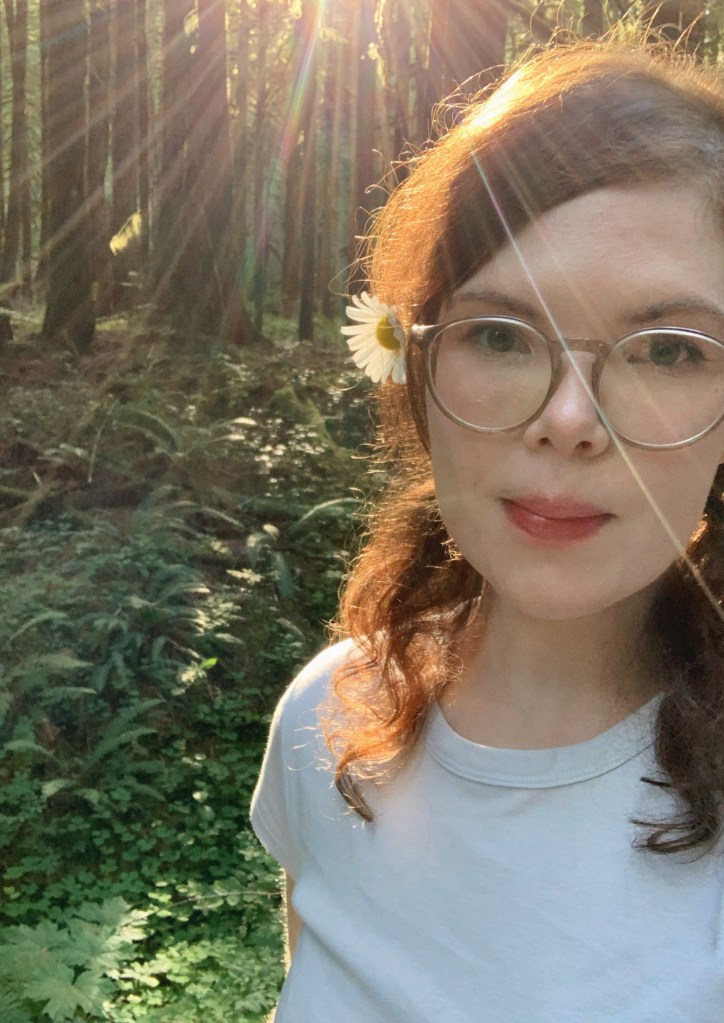
Emily Winfield Martin is the #1 New York Times bestselling author and illustrator of Dream Animals, Day Dreamers, The Wonderful Things You Will Be, The Littlest Family’s Big Day, Oddfellow’s Orphanage, Snow and Rose, and The Imaginaries. Emily is known to wander in the woods whenever she can. She lives in Portland, Oregon, in a little house with a hobbit door and lots of bookshelves.
A wildly huge thank you to Emily for taking the time to talk about her work with us. Be sure to check out her website at EmilyWinfieldMartin.com, and be sure to pick up a copy of The Wildest Thing, on bookshelves now!
 The Baby Bookworm