
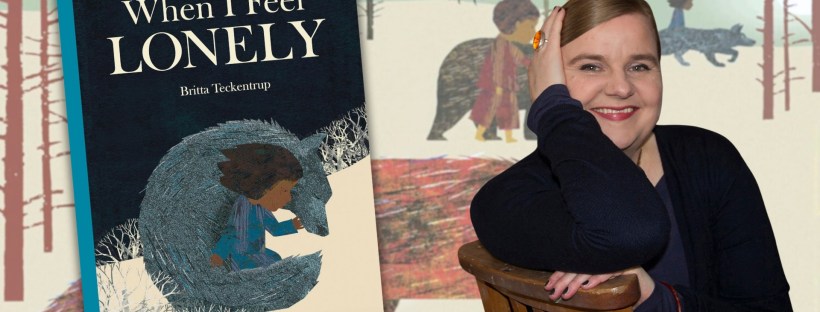

There are few emotional experiences more universal than loneliness. Yet for children, the relative unfamiliarity of loneliness can make it all the more acute: as they feel the sadness and separation that comes with feeling alone, they may also lack the experience to know how to end their loneliness.
In Britta Teckentrup’s newest picture book, When I Feel Lonely, the author-illustrator beautifully explores this feeling of isolation and how children can see themselves through—and beyond—it. I recently had a chance to talk with Britta about her work, inspirations, and the role of empathy in addressing loneliness.
Welcome to The Baby Bookworm, Britta! To start: When I Feel Lonely is the third book in a series that explores big emotions with little readers in an especially empathic way. What inspired this series, and how did you come to choose loneliness as the topic after the books on anger and bravery?
BT: I think that loneliness is a significant global problem in our times, affecting children, young adults, and individuals of all ages.

The “loneliness epidemic” after and during COVID led to a significant rise in feelings of social isolation and the need for more connection. I personally know a few young people who struggled after COVID and are still dealing with loneliness today. Talking to them was the main inspiration for my book.
Your book validates how overwhelming and intimidating loneliness can be while encouraging its readers to find ways to reach out to those who can offer support. How did you find the balance of acknowledgment and empowerment?

BT: That was quite tricky because there isn’t an easy way out of loneliness, and I did not want to come up with an easy solution. It takes time, hope, and courage.
My main aim was to describe and validate the feeling of loneliness, so children can relate to my main character. Realising that other people feel lonely too can open up a conversation and help children to investigate their own feelings and experiences. It allows them to show more vulnerability and be brave.
Like the previous two books in the series, When I Feel Lonely features an animal companion that helps guide the narrator through their big emotion. What do these companions represent to you, and what made you decide on a wolf for this theme?

BT: As I am a very visual person, I find it a lot easier to represent an emotion through an animal. It opens up the possibility of a conversation, and I am able to visually show the girl’s inner dialogue. The wolf is not just her inner voice; it also directs her in the right direction and gives her support and courage.
In When I Feel Brave, the featured animal was a bear. It represented fear, strength, and courage all at the same time. The wolf is ambiguous in the same way… it is an animal that needs a pack and is very social, but at the same time, we think of the ‘lonely wolf.’ I also liked the fact that a wolf is grey, which helped me visually.
If you had an animal companion to guide you through the turbulent times of your life, what kind of animal would it be and why?
BT: It would probably be some kind of bird or a cat. A cat, because I always had cats and they always soothed me and calmed me down. A bird, because I just love them and they always give me hope. I can’t wait for their first songs in springtime after a long and grey winter here in Berlin.
A powerful turning point in the book involves the realization that we are often unknowingly surrounded by others who feel lonely, too. Why do you think that this is such an important lesson for young audiences?

BT: So many times, children think that they are alone with their negative feelings. That it is just them and that something must be wrong with them. By realising that other children & adults feel the same way, the emotion becomes normalised, and it becomes much easier to talk about it and share your emotions.
The exploration of big emotions seems like a perfect fit for your writing and art style, both of which are known for capturing evocative scenes of the natural world. Can you walk us through your creative process when approaching a new book?
BT: Writing and illustrating books is my way of making sense of the world and responding to life.
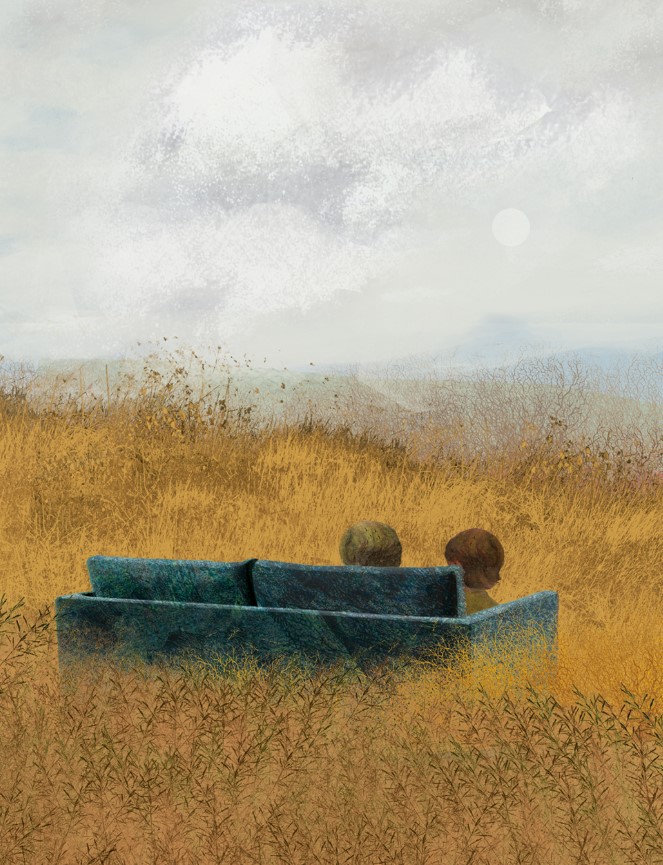
When I felt angry or scared or sad—I wrote a book…
When my grandmother died—I wrote a book…
When the divisions in the world started to grow—I wrote a book…
When my head was full of questions—I wrote a book…
Images tend to come to me first and help me to narrow down how I am feeling and what exactly I want to say. The text develops alongside the images until it all comes together and feels just right. It’s a little bit like a jigsaw puzzle with a lot of trial and error.
Are there plans to continue this series? If so, what emotions or themes are you keen to consider next?
BT: Yes, there are 🙂 I have got the feeling that happiness might be next. How we always chase it, how we try to hold on to it, and that it never stays for long. That we have to go through ups and downs in order to live and grow.
One of my favorite questions for children’s creators is about their childhood reading habits. Was there a book or series from your childhood that inspired you?
BT: I loved to read as a child. I loved my Eric Carle picture books and liked reading Michael Ende when I was a little older. I also remember Tomi Ungerer’s No Kiss for Mother, which I loved because it was so different.

Finally, in honor of When I Feel Lonely, what advice would you give to a reader of any age who wants to reach out to a potential friend but is unsure how to do so?
BT: That is a difficult and complex question. The advice that I have given to the people around me in the past was not always the right one, and I had to learn that there is no easy solution that fits all. It is not easy for a lonely person to reach out.

They might have had bad experiences with connections in the past or have a fear of being rejected. Connection is craved but does not always come easy.
Some suggestions might be: Be open to small interactions, be honest and be yourself, show vulnerability, listen and show genuine interest in the other person, find shared interests and experiences, don’t expect too much, be brave, find out about yourself, find out what you love and want…
About Britta Teckentrup

Britta Teckentrup has written and illustrated over seventy children’s books, which have been published in over twenty countries. Her books include Tree, Bee, Ocean, Moon, and Home in the Peek-Through Picture Book series, plus Big Smelly Bear, Grumpy Cat, and The Odd One Out. Born in Hamburg, Germany, and educated in London at St. Martin’s College and the Royal College of Art, she lives with her family in Berlin.
A huge thank you so much to Britta for taking the time to talk about her work and process with us. Be sure to check out When I Feel Lonely, on bookshelves everywhere now!
 The Baby Bookworm
One thought on “Lonely Is a Big Feeling: Interview With Author-Illustrator Britta Teckentrup”